
Online privacy is no longer a niche concern it's a mainstream expectation. People increasingly search for ways to protect their data, unlock geo-restricted content, and browse anonymously. That demand has turned VPN apps into one of the most consistently profitable app categories on both the App Store and Google Play.
But here's the opportunity most businesses miss: you don't need to be a cybersecurity company to launch a VPN app. With white-label VPN app development, you can bring a fully branded, feature-rich VPN product to market without building encryption protocols, servers, or infrastructure from scratch.
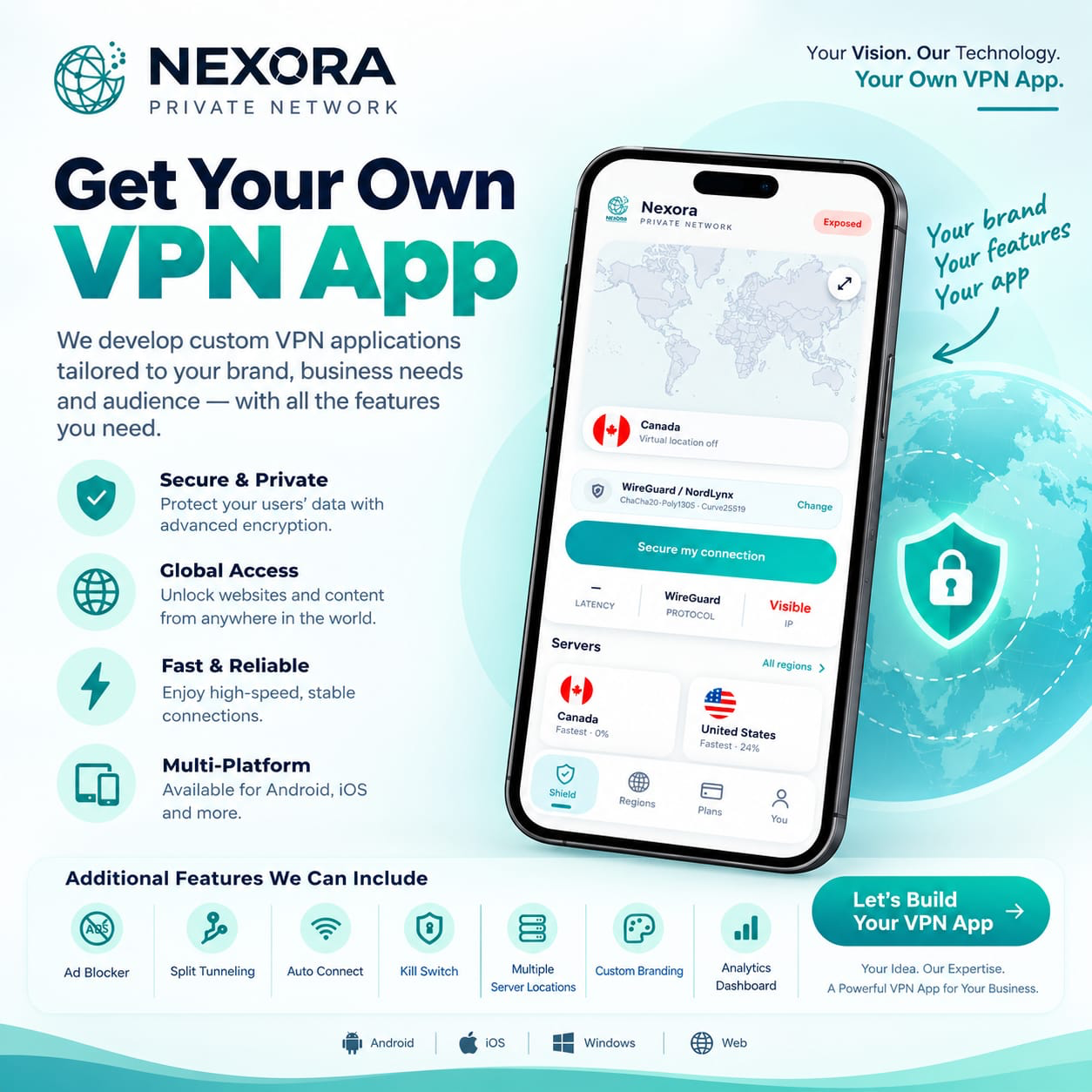
At Multi-Datum, we specialize in custom VPN app development helping startups, ISPs, SaaS companies, and digital agencies launch their own VPN app tailored to their brand, business model, and audience. In this guide, we'll break down what a white-label VPN is, how custom VPN app development works, what features matter most, and why now is the right time to build your own VPN business.
What Is a White-Label VPN App?
A white-label VPN app is a fully functional VPN application built with real infrastructure, encryption, and server networks that a development company customizes and rebrands for your business. Instead of spending months or years building a VPN from the ground up, you get:
- A production-ready VPN engine
- Custom branding — your logo, colors, and app name
- Your own features, pricing model, and subscription plans
- Full ownership of the user experience
Your customers never see the underlying technology provider they see your app, your brand. This is different from being a basic VPN reseller, where you're simply selling someone else's product under limited terms. With a true custom VPN app development partner, you retain control over branding, features, server selection, and how your product evolves over time.
Who Needs a Custom VPN App?
Custom VPN app development isn't just for cybersecurity startups. It's increasingly popular among:
- Digital agencies expanding into recurring-revenue SaaS products
- ISPs and telecom companies offering privacy add-ons to existing customers
- Content and media platforms helping users bypass geo-restrictions
- Businesses in regulated regions wanting secure, private connections
- Entrepreneurs entering the growing VPN market with a differentiated product
If your audience already trusts your brand, a branded VPN app is a natural way to add a new, high-margin revenue stream.
Core Features Every VPN App Needs
Whether you're building from scratch or going the white-label route, these are the non-negotiable features of a modern, secure VPN app:
Secure & Private Connections
Strong encryption (AES-256, ChaCha20-Poly1305) combined with modern, audited protocols like WireGuard keeps your users' data protected even on public networks. WireGuard's minimal codebase makes it fast and easier to audit than older options, while OpenVPN and IKEv2 remain valuable for device compatibility.
Global Server Access
Users expect to unlock content and services from anywhere in the world. A wide network of fast, reliable server locations (US, Canada, UK, and beyond) is essential for a competitive VPN app as is smart server selection that routes users to the fastest available node.
Speed & Reliability
Privacy means nothing if the app is slow. High-speed, low-latency connections with real-time server performance indicators (like "Fastest") keep users engaged and subscribed. Connection success rate and time-to-connect are the two metrics that predict churn best.
Multi-Platform Availability
Today's users expect consistency across devices. Your VPN app should be available on Android, iOS, Windows, and Web at minimum, with macOS, Linux, and browser extensions as common additions. Each platform requires native work from Android's VpnService API to Apple's Network Extension framework which is exactly the expertise a development partner brings.
Kill Switch & Auto-Connect
A kill switch instantly blocks all internet traffic if the VPN connection drops, preventing accidental data exposure. Implemented at the network level — not just inside the app, where a crash can silently bypass it — it's the feature that separates a VPN that genuinely protects users from one that only looks like it does. Auto-connect ensures protection starts the moment a device goes online.
Split Tunneling
Split tunneling lets users route some apps through the VPN while others use a regular connection — a highly requested feature for gamers, streamers, and business users. One honest caveat: full per-app routing is well supported on Android, Windows, and Linux, but iOS places real limits on per-app VPN traffic.
Ad Blocker
Built-in ad and tracker blocking adds real value for users and is a strong differentiator in a crowded VPN market. It's often the feature that tips a wavering user into a paid subscription.
Custom Branding
From splash screens to color schemes to app store listings, full custom branding is what separates a true white-label VPN app from a generic reseller product. Your customers should never see the provider's name anywhere.
Analytics Dashboard
A backend analytics dashboard lets you track usage, subscriptions, churn, and server performance — critical data for scaling your VPN business.
How Custom VPN App Development Works
Here's a simplified breakdown of the process when working with a VPN app development company:
- 1Discovery & branding – Define your target audience, brand identity, and feature set.
- 2Protocol & infrastructure selection – Choose encryption standards and tunneling protocols (typically WireGuard first, with OpenVPN and IKEv2 for compatibility).
- 3App design & development – Build native or cross-platform apps for iOS, Android, Windows, and Web.
- 4Server network setup – Configure global server locations for speed and reliability.
- 5Feature integration – Add kill switch, split tunneling, auto-connect, ad blocker, and more.
- 6Testing & security audits – Verify encryption integrity, test DNS/IPv6/WebRTC leak protection, and confirm kill-switch behavior on real devices.
- 7App store submission – Handle Google Play and App Store review with complete, accurate VPN privacy disclosures.
- 8Launch & post-launch support – Deploy to app stores and provide ongoing maintenance, updates, and scaling support.
Want the full technical picture? See how our custom VPN development solutions work.
White-Label VPN vs. Building From Scratch
| Factor | White-Label VPN Development | Building From Scratch |
|---|---|---|
| Time to market | Weeks | 12–18+ months |
| Infrastructure cost | Lower (shared/managed servers) | Very high |
| Technical complexity | Handled by provider | Requires in-house expertise |
| Branding control | Full control | Full control |
| Ongoing maintenance | Provider-supported | Fully your responsibility |
For most businesses, white-label VPN app development offers the best balance of speed, cost-efficiency, and brand ownership.
How Much Does a Custom VPN App Cost?
Cost is one of the most-searched questions in this space, so here's a straight — if approximate — answer. Industry estimates vary by scope and provider, but typical published ranges run:
- White-label launch: $5K–$40K — a setup fee plus ongoing network and usage costs
- Mid-scale custom build: $80K–$250K — multi-platform apps with a tailored backend
- Full custom build: $250K–$500K+ — proprietary protocol work and complete infrastructure ownership
The deciding variables are the number of platforms, protocol complexity, custom billing and backend features, and whether you need a global server fleet. If a provider quotes a flat price without first asking about platforms, protocols, and scaling plans, treat that as a red flag.
Security, Data Ownership, and App Store Compliance
Three topics separate a real white-label VPN project from a themed demo:
Security depends on the provider, not the label. A white-label VPN is as secure as the stack it's built on. Demand to see which protocols and ciphers are used, whether the apps are independently audited or open source, and what the provider's logging policy is. Leading implementations run no-log infrastructure, meaning the network itself doesn't retain your users' browsing data.
Your data, your relationships. You own the customer accounts, subscriptions, and the trust relationship — that's the entire point of going white-label. The provider's no-log network keeps user privacy intact while you retain account-level data like subscriptions and payments under your control.
App stores will scrutinize you. Both Apple and Google review VPN apps aggressively and reject apps with vague or misleading privacy disclosures. Expect to provide a clear privacy policy, plain-language data-collection disclosure, and evidence that your VPN actually follows it. A development partner that has shipped VPN apps through store review is worth far more than one that hasn't.
When Should You Build From Scratch Instead?
White-label isn't universally the right answer. Building from scratch makes sense if:
- You have funding and a genuinely differentiated idea — a novel obfuscation method, a decentralized node model, or a custom protocol
- You need deep control over the entire stack as part of a larger platform
- Your use case is purely internal, such as a private corporate network, where off-the-shelf infrastructure tools may already cover you
For everyone else — which is most companies — white-label gets you to revenue faster, cheaper, and with far less risk.